
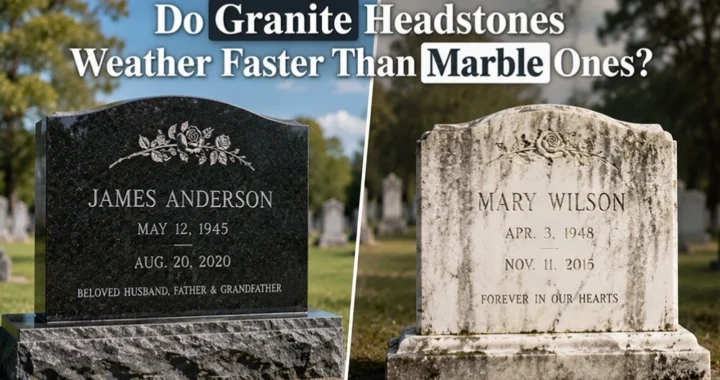
Do Granite Headstones Weather Faster Than Marble Ones?
Outline Summary
Many families ask this question when they choose a grave marker: do granite headstones weather faster than marble ones? The clear answer is no. In most cemetery settings, marble weathers faster than granite. Granite is the stronger choice for long-term use, while marble has a softer look that can change with rain, frost, sun, and air pollution.
This does not mean marble is a bad material. Marble has beauty, warmth, and history. Many old cemeteries in the U.S. and UK have marble stones that still move people. But for weather resistance, granite has the edge in the granite vs. marble comparison.
Why Granite Is Typically More Durable
Granite is a hard igneous rock that contains minerals like quartz and feldspar.
These minerals make granite resist most types of outdoor weathering.
Granite also has very low porosity, making it difficult for water to seep into the stone and cause cracks during freeze-thaw cycles.
According to the National Park Service, or NPS, all grave markers are left at the mercy of weather, sunlight, wind, rain, temperature changes and pollution. They also point out that because Marble is softer than granite. and more porous than granite, it is more prone to weathering.
This is the reason why a lot of cemeteries, dealers, and funeral homes recommend granite to families who wants a memorial that not only stands the test of time but also keeps its shine, form, and engraved letters for many years.
What Makes Marble Weather So Quickly?
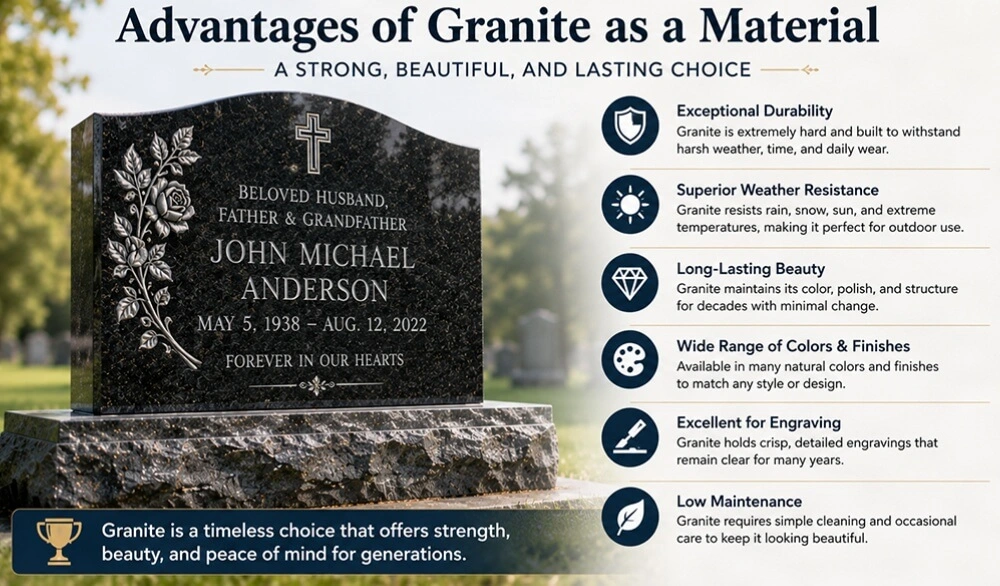
Marble is primarily composed of calcite, a calcium carbonate mineral.Calcite can chemically react even when it comes into contact with the weak acids found in rainwater., which are quite mild.
According to Earth Science Week, citing the Geological Society of America, marble tombstones are gradually disappearing because the calcite in them is reacting with the acid in rainfall. The source also mentions that the pace of weathering varies by location, pollution, and climate.
Research from University College London explains that marble is a highly susceptible material and erodes mainly by dissolving in acid rain. Besides, they explain that after about 10 years, marble stones may begin to look dull, losing their natural glossy appearance and their surface might become rough like granulated sugar.
This is the reason why marble inscriptions might get more difficult to read as time goes by.Even deeply carved letters, flowers, or portraits may gradually lose their definition.The process can be accelerated by factors such as rain, moss, lichen, and urban air pollution in some cemeteries.
Example of a Family
Sarah and her brother Tom were looking for a monument that would commemorate their mother. White marble, to Sarah’s mind, was the perfect color stone as it looked calm and gentle. Tom, on the other hand, wanted black granite as he had come across a couple of old marble gravestones in the local cemetery where the inscriptions had almost become illegible.
Their memorial retailer presented them with two samples. The marble sample was smooth and polished. The granite sample was quite heavy and solid. The salesman even told them that chemically marble and granite are different: marble gets eaten by acid rain, granite can resist acidic weathering much better.
However, Sarah decided to add a small marble flower engraving as a decorative feature, but the main memorial was granite. She reasoned, “Mom was always fond of simple things. I wanted to create something beautiful, but I also wanted her name to be visible.” It was a very personal decision. It’s not just about the science. It’s about memory, family, and love.
Does Location Matter?
Definitely. The effect of the environment can be a crucial factor. For instance, a marble headstone placed in a a dry, clean environment could possibly last longer as compared to one that is placed near heavy traffic, salt from the sea, or industrial air. Similarly, granite if not maintained properly can also get stained, cracked, or develop biological growth.
According to the National Park Service’s cemetery preservation guide, biological growth, pollution, salts, and freeze-thaw cycles may lead to the deterioration of stones. The guide also cautions against aggressive cleaning methods, power washers, wire brushes, and bleach as these may result in the loss of the stone’s original material.
Therefore, the first rule is: select a proper stone, and then care for it using the correct method.
Final Answer
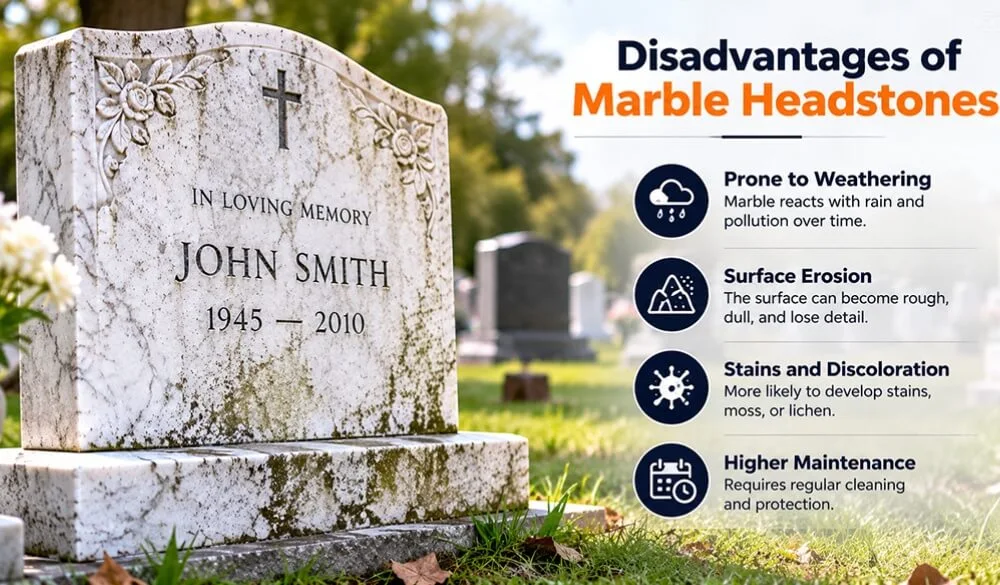
Usually, granite headstones do not weather at a faster rate than marble ones. Actually, marble is generally susceptible to weathering because it is soft, porous, and made of calcite which reacts with acidic rain. Granite on the other hand is known for its superior durability, ability to hold sharp lettering over long periods, and minimum surface loss.
Marble remains an exquisite choice of material for a memorial, particularly if the family is leaning towards the gentle white appearance. However, from the perspective of long-term outdoor performance, granite would certainly be the more dependable choice. A family may opt for marble for aesthetic reasons, granite for its robustness, or come up with a design that incorporates both.
The “best” headstone is not merely the one that lasts the longest. It is the one that is representative of the family’s love, budget, cemetery restrictions, and climate. A reputable dealer should be able to walk the family through these considerations even before any replacement or order is made.