
Table of Contents
Introduction
Funerals are important events for people to say goodbyes to a person who died. Most of the time, attending a funeral is a sign of respect and support. Well, sometimes you should not attend the funeral. This can be a difficult decision to make: you want to do the right thing, but you also have to consider what is best for everyone concerned.
According to the Natl. Funeral Directors Assoc., about 2.4 million funerals take place in the U.S. every year. Not everyone can-or should-attend every funeral they hear about. Sometimes, there are good reasons to stay home.
Health Concerns That Keep You Away
Your health matters a lot. Do not go to a funeral if you are sick with the flu, COVID-19, or another contagious disease. Funerals bring many people together in small spaces. You could make others sick.
This was the exact problem my friend Sarah had in 2022: her uncle passed away, but she had a bad cold with fever. She wanted to come and pay respect, yet she knew staying home was the right choice to make. So, instead, she sent flowers and a heartfelt letter to her aunt. The family understood and appreciated her being so thoughtful.
The CDC says that resp. illnesses spread very easily in crowded places. If you have symptoms such as coughing, sneezing, or fever, protect others by staying away. You can show your support in other ways, such as sending a card or making a phone call.
Mental health problems can also be a reason to skip a funeral. If being in crowds triggers serious anxiety or panic attacks, forcing yourself to go might do more harm than good. Taking care of your mental health is just as important as physical health.

When the Family Asks You Not to Come
Sometimes, the family of the deceased will make it plain that they do not want particular individuals to attend the funeral. This can, of course, be due to many factors: Perhaps there was some kind of fight or disagreement in the past. Perhaps the funeral is private and only for close family members.
A 2019 study by the Amer. Psychological Assoc., or APA, found that approximately 15% of families reported having at least one person they would prefer not to see at a funeral-a situation far more common than you might think.
If the family asks you not to attend, you must respect their wishes. To do otherwise would be impolite and add further hurt during a very painful period. The funeral is about the person that has died, but also about comforting the family: it’s never about you.
Tom had an experience like this. His ex-wife’s father died, but her new husband made it clear Tom was not welcome. Tom wanted to pay respects because he knew his former father-in-law for many years. But he chose to stay away. Instead he sent a donation to the man’s favorite charity. This showed respect without causing conflict.
Personal Conflicts and Past Problems
Sometimes, you have a history with the person who died or their family that makes going to the funeral wrong. Perhaps you had a serious fight that never got resolved. Maybe you hurt each other in ways that can’t be fixed.
Going to the funeral might seem like a good way to make peace, but funerals are not the place for that. The family is coping with grief and loss. They do not need extra drama or stress.
A woman named Jennifer shared her experience online. Her sister died, but they hadn’t spoken in five years after a big fight in the family. Jennifer’s brother told her that coming would be too much for their mother. Jennifer made the hard decision to stay home. She wrote a private letter to her sister and kept it to herself, which gave her closure without causing a disturbance at the funeral.
Research from the Jour. of Family Psychology finds that unresolved conflicts at funerals tend to increase everyone’s grief. Approximately 30% of people report family conflicts in connection with funerals creating lasting damage to relationships.
Distance and Logistical Challenges
Sometimes, practical reasons make it impossible or unwise to attend a funeral. If it’s several thousand miles away and you can’t afford the trip, you shouldn’t feel guilty about not going.
Travel costs money. According to the Bureau of Transportation Stats., a cross-country flight ranges between $400 and $800. Added to that are hotel stays, rental cars, and time off work. Not everyone can handle these costs-especially on short notice.
Sometimes, work commitments can cause a genuine dilemma. If you have an important meeting, deadline, or presentation and it isn’t possible to change the date, your absence from the funeral may be unavoidable. Most people understand that life doesn’t stop at the most sad times.
My coworker David had to skip his cousin’s funeral because that was the day he had scheduled surgery. Of course, he felt awful about it, but to change the date of his surgery would have postponed his treatment three months. His family understood his health came first.
Your Own Emotional Condition
People are all affected by grief diferently. Sometimes, you will be too emotionally fragile to attend a funeral. If seeing the person’s body or the tears of other people is going to send you into a breakdown, then don’t go.
Especially for people who have lost many or have PTSD, funerals can be trauma-inducing. According to the Natl. Institute of Mental Health (NIMH), 6% of adults in the U.S. develop PTSD at some point in their lives, and to them, funerals could act as triggering events.
One man, Robert, explained that he could not attend the funeral of his friend because his son had died just two months earlier. He was still processing that loss. Going to another funeral felt just too much to manage. He sent a message explaining this to the family, and they understood completely.
If you’re dealing with depression or suicidal thoughts, a funeral might make things worse. Your safety and mental health should come first. You can still honor the person who died in private ways that feel safer for you.
Work and Professional Boundaries
If a coworker dies or when a coworker’s family member dies, you might wonder if you should attend the funeral; this depends on your relationship with that person.
It could be awkward to go to a person’s funeral if you barely knew them. In most cases, the family won’t even know who you are. Your presence might feel strange rather than comforting.
In 2021, the Society for Human Resource Mgmt. did a survey in which 40% of employees reported feeling pressured to attend funerals of coworkers that they did not know well. Most human resources experts disagree and say you should only go if you had a genuine connection with the person.
Lisa was employed by a large company, where over 500 employees were working. When someone from another department passed away, she received an email regarding the funeral arrangements. She had never met this person. Lisa did not attend. She signed the office sympathy card. This was the appropriate response for her situation.
Conversely, if you worked closely with them for years, it is a sign of respect and support to attend their funeral. Use your judgment about the relationship.
Final Thoughts
It is never easy to decide not to attend a funeral. You may be concerned about how others will perceive your actions or feel guilty for not attending. Sometimes, however, not attending is what is best.
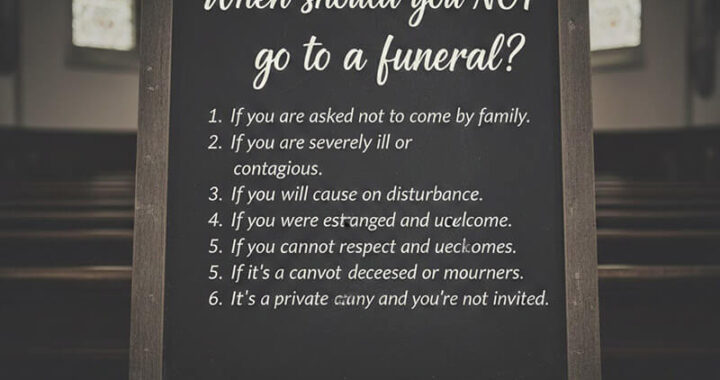
You should skip the funeral if you are sick, if the family doesn’t want you there, if there are serious unresolved conflicts, if you cannot afford or manage the trip, if you are just too fragile emotionally, or if you simply didn’t have any meaningful relationship with the person.
There are lots of ways to show respect and support without attending the funeral. You can send flowers, make a donation, write a letter, send a meal to the family, or reach out with a phone call a few weeks later after the initial shock has worn off.
Funeral industry statistics show that of the people invited to attend funerals, 20-25% for one reason or another do not attend. You are not alone in your choice.
Remember, the purpose of a funeral is to comfort the bereaved family and to pay your respects to the deceased. If your presence would serve neither of those purposes, it’s okay to stay home. Trust your gut feeling and do what works for you. The people who count in your life will understand.
vist more: https://www.cnmonument.com/blog