
How Amish Funeral Rites Differ from Modern Secular Services
📋 Table of Contents
- • Introduction
- • The Preparation of the Body
- • The Funeral Service Itself
- • Burial Practices and Cemetery Traditions
- • Community Involvement and Support
- • Contrasts with Modern Secular Services
- • Conclusion
Introduction
Sarah Miller was at her grandmother’s funeral in Lancaster County, Pennsylvania when she had a glimpse of something totally different from the funeral she’d been to for her college roommate’s father just a few months before.
Unlike in the funeral home with soft music and professional directors, Sarah’s Amish family was meeting at the farmhouse where her grandmother had lived for sixty years. The body was family work, the casket was a neighborhood handiwork, and over three hundred people came not because Fb invitations but through word of mouth transported by horse and buggy.
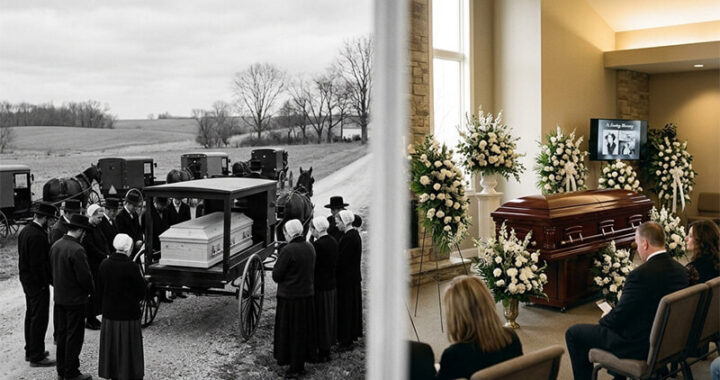
This clear difference throws light on a basic fact: Amish funeral customs are still very much the same as those old traditions which emphasize togetherness, being simple, and also being spiritually ready and at the same time, they are the exact opposite of modern secular services which usually highlight individual memory, professional services, and personal celebration of life.
The Preparation of the Body
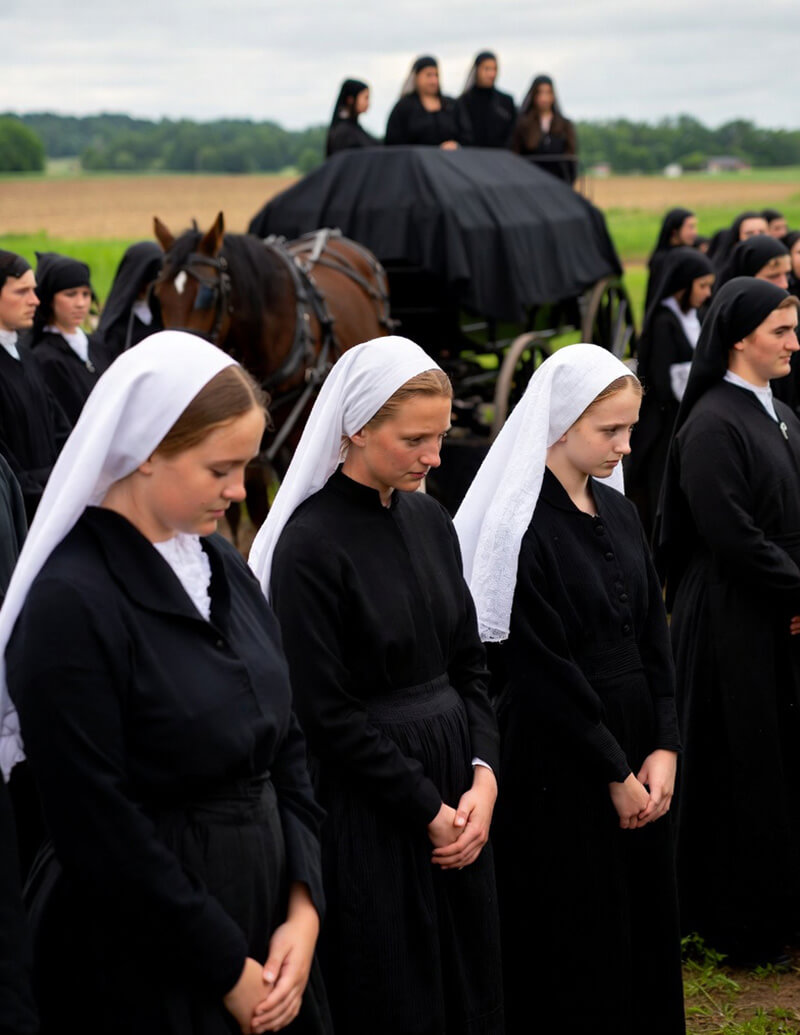
In Amish communities, death is treated with close, personal attention which is something that the wider society has basically delegated to others. When their 74-year-old father Jacob Yoder passed away peacefully in his sleep in Holmes County, Ohio, the sons of the deceased notified the GP and local undertaker at once, however the primary responsibility for the preparation of the body still rested with the family.
The Amish wash and dress the dead in plain, simple clothes, usually white garments for the burial. It is the family members of the deceased’s m/f gender who carry out this work, most of the time, in a day of death. After that, the body placed in a basic wooden coffin, which is often built by local craftsmen who are the neighbours or family friends. The Amish caskets uses no metal parts, only wooden pegs, which is a way of showing their commitment to simplicity as well as their belief in natural decomposition.
In contrast, nowadays the secular services usually rely on professional funeral directors who take care body preparation. The deceased is normally embalmed (which is a process requiring the use of FDA-regulated chemicals), dressed up in the formal clothes selected by the family, and shown in the e commercially produced caskets that can be very costly from $2,000 to more than $10,000. The NFDA states that the average cost of a funeral in the United States amounts to $7,848, not counting cemetery expenses.
The Funeral Service Itself
Emma Stoltzfus was deeply impressed with the unadorned simplicity of her uncle’s Amish funeral service when she was there in Bird-in-Hand, Pennsylvania. The service was held in the family barn, with the over 400 persons present seated on long, plain wooden benches without backs. There wasn’t any organ music, no speeches in praise of the deceased’s accomplishments, and no exhibits or video tributes showing the deceased’s life.
Real Example: Service went on for about an hour and a half. The entire time the congregation spoke in Pennsylvania Dutch (a dialect of German). Two or three different ministers delivered sermons on themes of human mortality, Christ’s resurrection, and the need for people to be ready for death. The congregation sang hymns from the Ausbund, a 16th-century hymnal, in unaccompanied four-part harmony, very slowly.
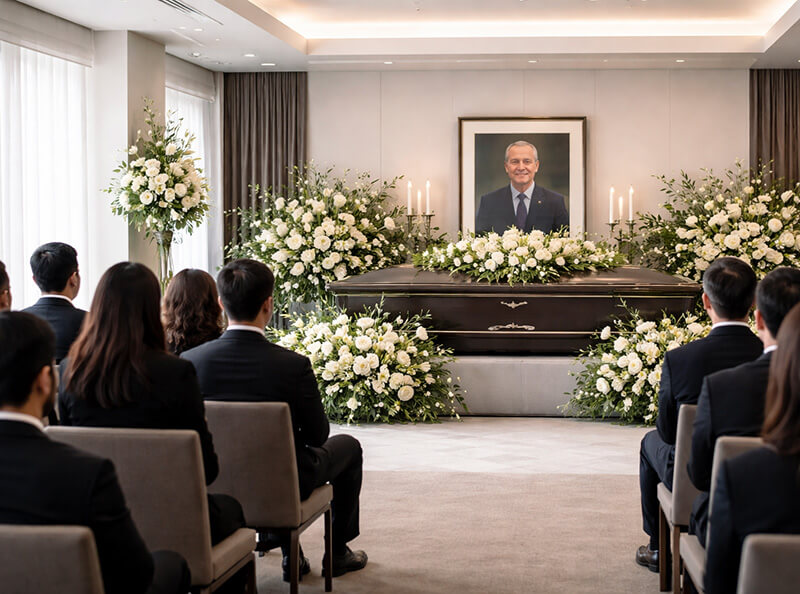
Often the secular memorials nowadays are held in funeral homes, churches (for mainly cultural rather than religious purposes), or even outdoor locations selected for their personal significance. They are usually loaded with the DVD tributes, slideshows of the deceased’s favorite muzic, several personal eulogies by different speakers, and sometimes the service is even livestreamed for the folks who are attending remotely by means of Zoom, or some other platform.
In addition, the content centered around the divine differs notably. Whereas Amish funeral services highlight being at God’s will, living in this life is but a prelude, and being ready for the last judgment, the ministers in the churches habitually are reminding the audience that their righteous living will be judged and the knowledge of their own mortalities should lead to it. On the other hand, the secular services mostly focus on the deceased’s life achievements, character, and relationships, with less talk of life after death or moral lessons.
Burial Practices and Cemetery Traditions
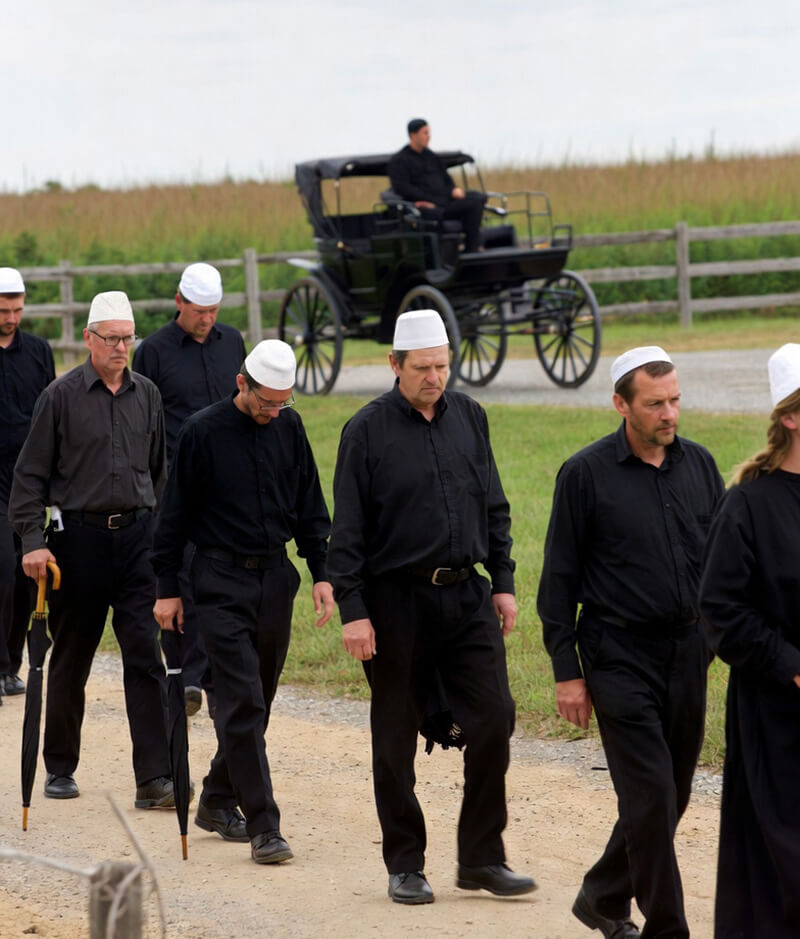
After the funeral of his father, Daniel Beachy was one of the 200 men and teenage boys in the funeral procession to the Amish cemetery a small plot of land on a farm that was given to the community long time ago. The coffin was brought on a plain horse-drawn wagon, and a long line of black buggies followed slowly around.
At the grave, the coffin was lowered to the ground by hand with the use of ropes, and the male family members and close friends went down into the grave one by one to shovel in the earth it was a long time, nearly an hour, Task. This kind of active participation in the burial is not only a last service but it is also a very direct exposure to the reality of death.
Theaters of the modern secular burials tell a completely different story. Most of them happen in commercial cemeteries with elaborate headstones, monuments, and personalized markers. For religious reasons, cremation is forbidden in the traditional Amish communities, whereas many families opt for this choice (it was about 56% of the US deaths, according to the NFDA, in 2020).
Families that choose cremation in secular settings often scatter ashes in places with personal significance, keep them in decorative urns, or even use them for making jewelry, reef balls, or fireworks all of which would be considered totally off limits in the Amish tradition. Other things common in modern services but totally missing in Amish burials include the lowering of caskets with machines, the use of concrete burial vaults to stop the ground from settling, and paid pallbearers.
Community Involvement and Support
One of the most noticeable differences between Amish and modern secular funeral traditions is probably the extent to which the community is involved. For instance, when Mary Lapp’s husband passed away suddenly at the age of 52, she didn’t have to request assistance it just happened.
Real Example: Neighbor women promptly arrived to clean the house and to provide food after her husband’s death. Men fashioned the coffin and excavated the grave. The community prepared and provided a meal for more than 300 people after the service. In the following weeks, various families kept taking turns to help Mary with farm activities, stock her firewood, and she was never left alone to grieve.
This kind of collective response is actually the norm, not the exception. Amish funeral aid does not involve NGO charities or online fundraisers like GoFundMe rather, it emanates from the community’s awareness of mutual obligation and the practice of Gelassenheit (likelihood of the members’ consent to and their self-surrender to God’s will).
On the other hand, in modern secular societies, grieving individuals are often expected to deal with the loss more on their own. Although friends and family do provide support, the main responsibility for arranging services, handling the finances, and dealing with practical issues usually falls on the immediate family members. It might be suggested to those grieving to seek help from professional grief counselors, join support groups, or undergo CBT interventions, which indicate a more personalized and healing approach to mourning.
Contrasts with Modern Secular Services
Tom Richardson, who had only experienced modern memorial services, realized the major differences in philosophy between these ways of death only when he accompanied his colleague to an Amish funeral.
Commercialization vs. Simplicity: Our modern world has turned funeral services into a major business. Besides embalming, cosmetic preparation, rental of facilities, printed materials, and caskets most of the family members’ money is spent on these. Amish folks hardly spend any money besides wood for the casket and food for the meal, with all the rest of the labor being volunteered.
Individualization vs. Uniformity: Designing personalized services is a modern trend whereby families choose everything from casket colors to memorial video soundtracks. To give an illustration, Tom recently went to one secular service where it was a motorcycle-themed casket for an enthusiast, and the mourners were wearing leather jackets instead of suits. An Amish funeral, on the other hand, is very uniform the same hymns, the same sermon themes, the same plain wooden caskets, no matter who died.
Technology vs. Tradition: Nowadays many mourners use all sorts of technological gadgets to modernize funerals including livestreaming, online memorial pages, QR codes on headstones linking to video tributes, and digital guestbooks. Some families also create memorial websites or social media pages that remain active indefinitely. Amish don’t use any of these technologies and they stick to the way their ancestors would recognize them after centuries ago.
Speed vs. Deliberation: Usually, it takes some time before a secular funeral is held, sometimes even weeks or months after death, especially when cremation is chosen, to facilitate relatives visiting from a distance. In most cases, Amish funerals are held within three days of a person’s death and while this certainly requires the community to mobilize quickly, it also offers the community a speedy closure and communal grief processing.
Conclusion
The variation between Amish funeral customs and modern secular ceremonies illustrates the fundamental differences in attitude towards death, community, and the purpose of a life well-lived. Sarah Miller, who compared her grandmother’s Amish funeral with a secular one she had attended a few days prior, came to realize that both approaches had their own merits.
The Amish funeral tradition entails strong emphasis on the support of the community, spiritual readiness and the great equalizer death that makes everybody, whether rich or poor, have the same simple burial. This tradition keeps reminding the participants that besides themselves, they belong to a larger entity and that death is just a natural transition rather than a tragedy one hides through cosmetics and fancy staging.
On the other hand, a contemporary secular funeral aims at celebrating uniqueness and offers tailored ways of saying goodbye that really reflect the person’s life. These services can easily adjust to different beliefs (or non-beliefs) with regards to the afterlife and also can use technological advancements to connect with mourning relatives who live at a distance.
Whether a person discovers more significance in the stark uniformity of an Amish funeral or the personal commemoration of a modern memorial, these different rituals ultimately serve the same human requirement: acknowledging death, remembering the deceased and assisting those left behind to come to terms with loss. Though methods differ greatly, the inherent human need for ritual at the time of death is a shared aspect of all cultures and belief systems.