
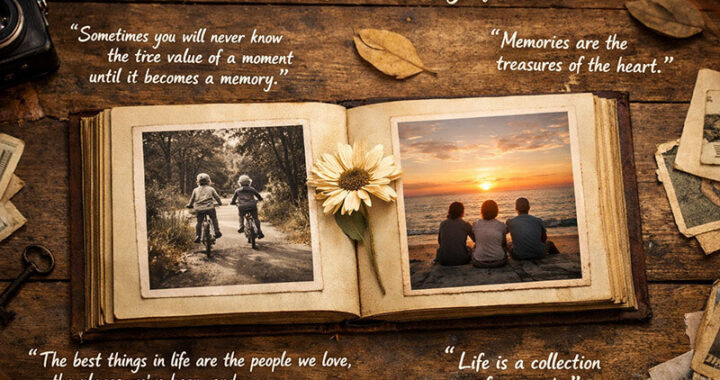
Words that remind us why the past is worth carrying forward.
📋 Article Outline
Why Memory Matters in Human Life
Memory is much more than a simple storage unit in our brains — it is the very thread that weaves our personal identity together. Over the centuries, philosophers, poets, and ordinary people have tried to describe, through words, the essence of remembering a person or thing that we love. The most profound memory quotes are not just poetic; they deeply connect with us because they reflect a shared human experience.
In fact, when we are grieving the death of a loved one, reminiscing about our childhood, or simply wishing to preserve a moment that is slipping away, memory quotes come to our rescue by providing us with words for the inexpressible.
A 2019 study published in Nature Neuroscience indicated that memories with a strong emotional component are stored more strongly encoded in the hippocampus. That is one of the reasons why quotes about memory often bring out powerful emotions — they activate real neural pathways connected to the actual experience.
Famous Quotes on Memory From Around the World
These quotes were written by famous writers, leaders, and great thinkers from different parts of the world who deeply recognised the power of recollection.
“
“Past, present, and future are distinctly separate only because we have a very difficult time giving up this false idea.”
— Albert Einstein, physicist born in Germany (1879–1955)
“
“Memory is the mother of all wisdom.”
— Aeschylus, playwright from Ancient Greece (525–456 BC)
“
“Without memory there is no culture. Without memory there would be no civilisation, no society, no future.”
— Elie Wiesel, Nobel Peace Prize laureate, born in Romania
“
“We do not remember days, we remember moments.”
— Cesare Pavese, Italian poet and novelist (1908–1950)
“
“Memory of the heart expels the bad memories and it enhances the good ones; and it is through this deception that we are able to bear the weight of the past.”
— Gabriel García Márquez, Colombian novelist and Nobel laureate
Real Stories Behind the Quotes
🌍 Story from Japan
Japanese author Haruki Murakami expressed in Norwegian Wood: “Memories warm you up from the inside. But they also tear you apart.” Such words struck a chord with the Japanese population, who faced loss and turmoil after the war. Murakami grew up in a Japan still haunted by WWII memories, thus his writing resonates with both his personal and the collective experience. The book has been read by more than 10 million people in Japan alone.
🌍 Story from France
French author Marcel Proust wove seven books of In Search of Lost Time around the concept of “involuntary memory” — how a mere sensory stimulus (for example, tasting a madeleine cake) can suddenly bring back a whole series of memories. The work is one of the major treatises on human memory in the world of literature. Proust’s treatment of memory is still inspiring neuroscientists and psychologists.
🌍 Story from India
Indian bard Rabindranath Tagore, the first person from outside Europe to receive the Nobel Prize in Literature (1913), penned the theme of memory and desire through many of his verses. He considered memories not to be mere sadness but instead a love that continues even after physical separation. His poem Gitanjali talks about memory being like holy places where we keep coming back.

What Science Says About Memory & Emotion
The PTSD research field has recognised that negative memories can be as vividly retained as positive ones, thereby confirming what García Márquez said: sometimes the heart remembers wrongly, but it remembers intensely. A pioneering MRI study conducted at University College London (UCL) in 2021 found that during people’s thoughts of their happy memories, simultaneous activation occurs in the PFC and the amygdala — the same brain areas triggered when one experiences joy in the present moment. In a nutshell, remembering a pleasurable event is almost almost as powerful as living it.
That’s why we’re so moved by memory quotes — when we read them, we don’t just get the point logically. Our emotional brain network gets the same feeling again. So, a memorable quote is not merely a sentence but a gateway.
How to Use Memory Quotes in Daily Life
Memory quotes can be much more than words on a card. Below are authentic ways people worldwide use them in their daily routines:
Starting your journal entry with a memory quote can be very therapeutic. Many mental health counsellors in the UK and Europe advocate this method as a way to help process grief — it gently contains difficult emotions.
Various cultures — ranging from Japanese Obon festivals to Latin American Día de los Muertos — use wise words as a way to honour the dead without being overtaken by grief.
Changing your phone wallpaper to your favourite meaningful memory quote is a small but powerful way of staying centred, especially during times of stress when we tend to forget what really matters.
— A timeless truth, cherished worldwide
stand the test of time because they resonate with human nature. They don’t guarantee that remembering is always a walk in the park — they just confirm that it is something worth doing every time.
Read More: https://www.cnmonument.com/blog