
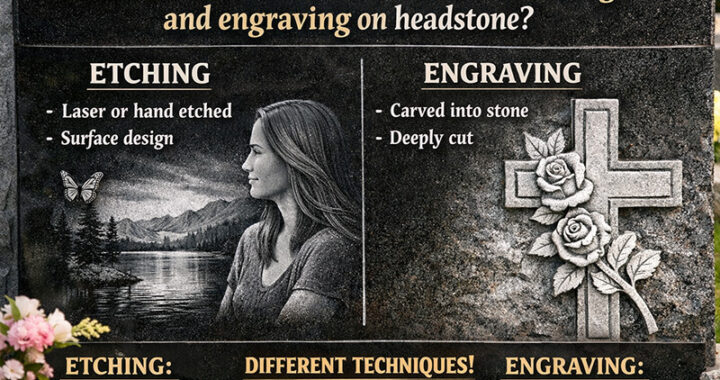
What is the Difference Between Etching and Engraving?
Understanding two distinct methods of creating lasting impressions
Table of Contents
Creating memorials, jewelry, or ornamental items that are durable brings etching and engraving into consideration. While the two words are often used interchangeably, they refer to distinctly different processes. Knowing the difference can help you decide whether an etching is appropriate for your memorial headstone, family heirloom, or personalized gift.
The Basics: A Study of Etching and Engraving
Engraving
Engraving is the subtractive process in which material is physically removed from the surface using cutting tools or lasers. Grooves, lines, and designs are made by the tool while cutting into the material. Think of it like carving: you take material away to create depth. (usually anywhere from 0.1-1.0mm deep).
Etching
Etching, on the other hand, involves the removal of material through a corrosive or abrasive process. In the traditional process of etching, acid reacts with and eats away the unprotected areas of the surface. More contemporary etching may also incorporate sandblasting or laser technology. Generally, it is a shallow process (approximately 0.05-0.5mm).
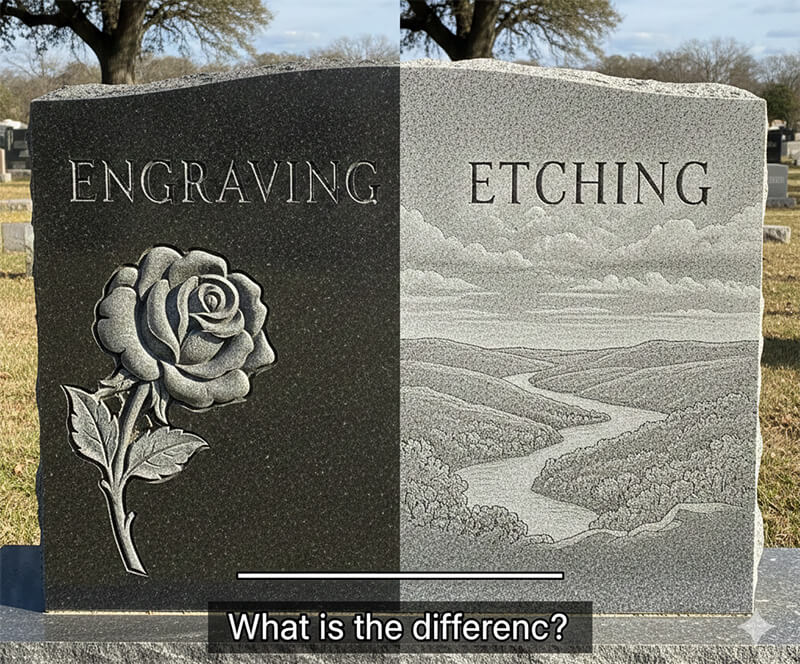
Key Differences Explained
Materials Removal
Engraving: Physical force – cutting, scraping, or burning (with lasers) is applied for a direct removal of material.
Etching: Removal is achieved with chemical reactions,abrasive or controlled erosion processes that dissolve or wear away the surface.
Depth and Precision
Engraving: Deep, precise cuts. Good for sharp lines and fine details, with very accurate control over depth.
Etching: Shallow, soft-edged impressions. More conducive to larger areas and artistic effects, like shading.
Durability and Longevity
Engraving: More durable due to deeper cuts. UK heritage surveys show that engraved headstones from the 1800s remain legible today, while shallow etchings from that period have mostly faded.
Etching: Less durable with time, vulnerable to weather exposure. However, if maintained properly, modern laser etching can easily last over 50 years on granite.
Cost and Time
Engraving: More expensive generally due to equipment and time taken. A hand engraving can take several hours, while laser engraving is faster but costs £10,000-£50,000 (GBP) for equipment.
Etching: Most times, this is advantageous for large designs. Chemical etching allows the processing of several pieces at the same time. Sandblasting equipment costs around £2,000-£8,000 (GBP).
Real-World Examples
Example 1: The Melbourne Heritage Cemetery Project (Australia)
A restoration project on the historical headstones put up in the mid-1850s was tackled at the Melbourne General Cemetery in 2018. What this project demonstrated were very interesting insights into the duration of different techniques.
Conservation specialists noted that hand-engraved inscriptions on granite and marble have been very close to 170 years old and very deep, about 3-5mm in depth, by contrast, many etched designs show significant weathering, many designs having gotten faint or completely eroded.
“The engraved text could still be read easily, even without touching it,” noted restoration expert Sarah Williams, “but the etched floral borders required careful lighting and examination to even detect. This taught us that for memorial work requiring multi-generational durability, deep engraving is irreplaceable.”
Example 2: The Japanese Art Glass Studio in Kyoto
In his traditional glass art studio in Kyoto, Japan, Master craftsman Hiroshi Tanaka produces engraved and acid-etched glassware. His work shows how different techniques have been known to serve different artistic purposes.
Diamond-point engraving gives clean, sharp lines when cutting into the glass surface for family crests (mon) and when creating precise calligraphy. Fine details down to 0.2mm wide with depths of 0.5-1.0mm can be accomplished using this technique.
Cherry blossom patterning and artwork scenery will be acid-etched, creating a frosted, translucent effect. The shallower, softer 0.1-0.3mm depth allows light to diffuse beautifully and creates dreaminess, a trait found in traditional art in Japan.
“Engraving speaks with clarity and permanence,” Tanaka defines. “Etching whispers with subtlety and atmosphere. A master knows when to use each voice. For a wedding gift that will be appreciated for generations, I engrave names and dates. For seasonal ornaments, I etch flowing patterns.”
Traditional vs Modern Techniques
Engraving Types
Hand Engraving
Chisels, gravers, and burins are the traditional tools used. It is still mainly used in artistic work and other custom designs. Widely practiced among UK jewelry trading, notably in Birmingham’s Jewellery Quarter.
Rotary Engraving
Rotary engraving uses rotating cutting tools (CNC machines). This is fast and very precise in engraving text or logos. Most of the factories prefer this kind of execution and also manufacture trophies using this method.
Laser Engraving
The modern method focused on vaporizing the material using laser beams concentrated in a small area. There is a very high-level precision capability up to 0.01 mm. Since 2000, it has been widely accepted, and up to this time, it is approximated that about 60% of commercial engraving in the UK uses it.
Etching Techniques
Chemical Etching
A traditional method in which acids (hydrofluoric acid for glass and ferric chloride for metal) are used. Parts to be protected are covered by a mask of resistant material. A time-consuming process that offers unique and great effects in art.
Sandblasting
Sand is propelled and has been forced against the surface at high velocity causing eroding of that surface. Typically used for memorial stones and architectural glass. Frosted, matt finish. Depth control: 0.1-2.0mm depending on pressure and duration.
Laser Etching
Uses laser at a lesser power to change the color/texture on the surface without deep change. It creates photographic quality images on stones. Popular for memorial portraits; increased by around 300% in Australia from 2015-2023.
Uses and Applications
⚡ Engraving: Most Suitable For
- Inscriptions and dates in memorial headstones and grave markers
- Customization of jewelry with personal inscriptions
- Awards and trophies
- Marking of industrial parts with serial numbers
- Finest calligraphy, and detailed artwork
🎨 Etching: Best For
- Decorative patterns on glass and mirrorware
- Artistic designs on memorial stones (landscapes, portraits)
- Printed circuit boards (in PCB designing)
- Architectural glass panels
- Photographs and complex shading on granite
Which Method Do You Prefer?
Consider the Following:
Purpose and Longevity: If you require inscriptions that will stand the test of time (for instance, memorial inscriptions), engraving is the way to go. For ornamental parts that can later be renewed or changed, etching is appropriate.
Material Type: Both hard materials – granite and metals – are most suitable for engraving. Glass and soft stones can be most beautiful when etched. Some projects, though, combine the two-laid out text with etched artistic illustrations.
Design Complexity: Fine lines and small text require precision of engraving. Larger artistic areas, shading, and photographic images are handled better through etching.
Budget: Engraving, in general, costs about 20-40% more than etching for the same sizes. However, compared to the permanent installations, the durability often justifies the investment.
Environmental Exposure: Installation outdoors, where some exposure to weather occurs, should be engraved, because of durability. For aesthetic purposes, they can either use etching or engraving for their indoor pieces.
Final Thoughts
The difference between etching and engraving provides you with the necessary understanding when it comes to making an informed choice regarding your memorials, artistic, or personal projects. It must be noted that engraving is probably the most durable form of memorial. By comparison, etching is somewhat less durable yet tends to be a more cost-effective method by providing some artistic flexibility in the project. Many stunning projects incorporate either of the modalities of strength for essential text while using etching’s subtlety for the sympathetic decorative elements. The best option depends on what you’re looking for, your budget, and your aesthetic preferences.
We Are Professional Headstone Manufacturers
We have spent many decades supporting memorials that invariably uphold the dignity of your loved ones with craftsmanship that ranges from the traditional hand engraving to the modern laser techniques. Our qualified artisans understand the nuance between each method and will advise on the best course for your memorial to remain legible and elegant for generations to come.
Let us create a memorial with you that will last.