
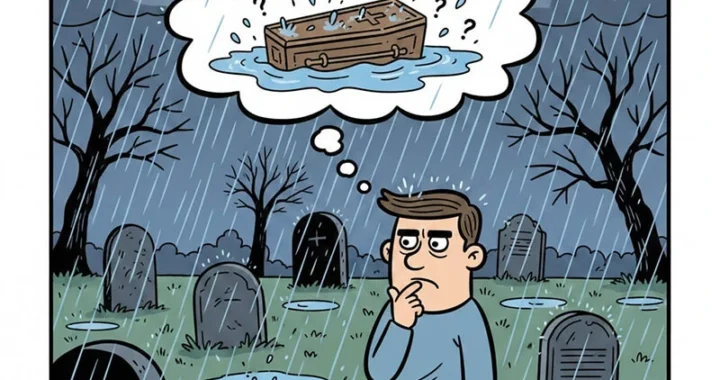
Do Coffins Fill Up With Water Upon Being Buried?
📋 Table of Contents
Understanding the Question
Many people wonder what coffins look like after burial. The popular question that burdens families is whether water enters those coffins, but this concerns families finding it important to know how their deceased rests in peace. This is science, cemetery practices, and raw human emotions.
Yes, mostly coffins fill with water. This is an overview of how the process happens; the period as well as the amount depend on factors such as GWT level, soil type, coffin material, and burial depth out of many many factors. Some coffins are effective in resisting water than others.
What Happens Underground
A coffin will be subjected to pressure by the soil downwards once it is buried. The standard grave is basically about 6 ft deep. The weight of earth tends to confine the burial container. In subsequent months and years, this could increase these external pressures towards developing small cracks or openings.
Scientific Fact: According to cemetery studies, wooden coffins start to show the entering of water between the periods of 6 months and up to 2 years in places that are highly humid. Metal caskets hold some years without getting damaged (5-10 years), but eventually, all breaks down.
Among all natural ways, water moves in soils: it rains on the surface of the earth; the trickling permeation through soil and beneath rock layers. That water is looking for lower points. Whenever the coffin lies below the GWT, however, water is trying to enter. You can think of it slightly like a boat with tiny holes-water finding a way in.

Where Does The Water Come From?
There are many sources through which water enters coffins, the main of which is groundwater. GWT refers to the level below which the ground is always wet, and in some places this table is just about a few feet below the surface; in others, it could be 20 or 30 ft down.
Then there’s rain. Heavy rain would pool water in the pockets of the soil, and that water would go down in the earth. An entire cemetery could thus lie under floods. Some old graveyards have been experiencing flood problems for decades.
Morning dew and humidity play a part too. In even the driest climates, some moisture exists in the air and in the soil. These couple drops may condense inside a sealed coffin, making water droplets, and over time, these droplets collect.
Burial Containers Differ
Not all coffins are created equal. Material makes a significant difference in how water gets inside a coffin. Let’s take a look at the different kinds:
A wooden coffin is traditional and valuable. Pines, oaks, and other woods deteriorate with time. It absorbs water like a sponge so that in the first year, moisture will seep into the grain. most wooden coffins end up more or less with a lot of water inside them by year five. Eventually, the wood starts rotting.
Metal caskets come in steel, bronze, or copper. Much better than wood, metal caskets resist water. On top of that, steel caskets have rubber seals around the lid; this seal could last several years. However, you cannot draw a line between wood and metal. It’s bound to rust. Corrosion occurs, even in stainless steel, while underground. It goes through tiny holes to let in a trickle of water. Bronze and copper last much longer – sometimes 50 yrs or more – but they too fail at some point.
Another new option is the fiberglass casket, which is not as much sealed as metal, since they resist water better than wood. However, they can crack under pressure; thus, once this happens, water rushes in.
Real Cases and Examples
Real-world examples will help us grasp this better. The city of New Orleans constructed above-ground tombs because of how high the GWT sits. Cemetery historian Sarah Thompson has recorded events regarding what happens when people bury coffins in that area. She has found that here wooden coffins start filling up with water within 3 months, turning the entire burial chamber into something like a small pond.
Case Study: In North Carolina flooding from Hurricane Florence forces the workers at Oakwood Memorial Cemetery to deal with displaced coffins. Upon examination, workers found that even the so-called “sealed” metal caskets contained 20 to 40 gallons of water.
Another example would be from England. James Miller worked for 30 years at a historic graveyard in Yorkshire. While he participated in various grave relocation projects, he reported that every single coffin they handled- no matter what age, material, or type-held water in some quantity. The oldest graves had coffins that rotted away, leaving just bones sitting in muddy water.
In Texas, the dry climate creates different conditions. For example, Roberto Garcia manages a cemetery in El Paso. Considering the area has very little rainfall, coffins here have increased resistance to moisture. Still, underground moisture exists even in the desert. Garcia has noted that after 15 to 20 years, most caskets begin to show some signs of water entry.
Burial Vaults and Protection
Some cemeteries demand burial vaults. The vault is a coffin-sized concrete or metal box. Think of it as a protective casing for the coffin that fits into the ground.
The purpose of a vault is two-fold: One, it prevents the ground from sinking when the coffin breaks down, keeping the cemetery surface intact and tidy. Two, it provides some measure of protection from water, albeit imperfect.
Even sealed vaults would eventually let water inside. Concrete vaults can crack. Metal vaults won’t hold out forever either. The EPA studied vault failure rates in the 1990s. They found that the standard concrete vaults begin to fail in 10 to 15 years. Water infiltrates through the cracks in the concrete or gaps in the seal.
Higher-end vaults made from thick plastic or bronze-lined concrete have much longer lifespans. Some makers even claim their vaults last 100 years or longer. However, no vault is everlasting. Every material will break down over time.
How Water Affects Decomposition
Water influences the decomposition of bodies. Under dry conditions, mummification can occur, whereby lack of moisture preserves tissue. In wet conditions, decomposition proceeds faster in some aspects but more slowly in others.
Water provides a habitat for various bacteria to thrive, which decompose organic matter. Under presence of water, there are thriving bacteria. These bacteria work quickly to decompose tissue. Water also prevents the movement of oxygen, and so certain form of decomposition is blockaded.
Scientific Evidence: The CDC has conducted research showing that water-logged coffins can give rise to adipocere or “grave wax.” This is a waxy substance that forms when the body fats mix with water and bacteria. Adipocere can preserve fleish for decades and even centuries.
Some families are opting for natural burials owing to those concerning issues. In essence, natural burial means no embalming, no vault, and a simple biodegradable coffin. This way, the body goes back into the earth in a more organic way. Water does still get into these coffins, but that is part of the natural cycle.
Ways to Prevent Water Entry
Can water be stopped entering a coffin? The answer is a big fat no. Well, not forever. But you can delay the entry. The following methods help do just that:
Select the proper casket: Steel and bronze caskets of heavier gauge will resist water for the longest period. Although more costly, they offer better protection. Rubber gaskets that seal around the lid keep water out for years.
Choose a good vault: Having a polymer or bronze-lined vault adds another layer of protection. These vaults resist cracking and corrosion better than those made of simple concrete.
Choose the right location: Graves placed on top of a hill drain much better than those set in a valley. Inquire with the cemetery staff about areas with better drainage. Avoid places near streams or ponds.
Consider depth: Some cemeteries offer deeper graves. An 8-foot deep grave might stay above the GWT while a 6-foot deep grave would stay in wet soil. This extra depth may incur costs; however, it alleviates some water issues.
Still, bear in mind that all of the above will only prolong the eventuality. Water is patient. Given time, it will eventually find its way. This is natural to burial.
Cemetery Rules & Regulations
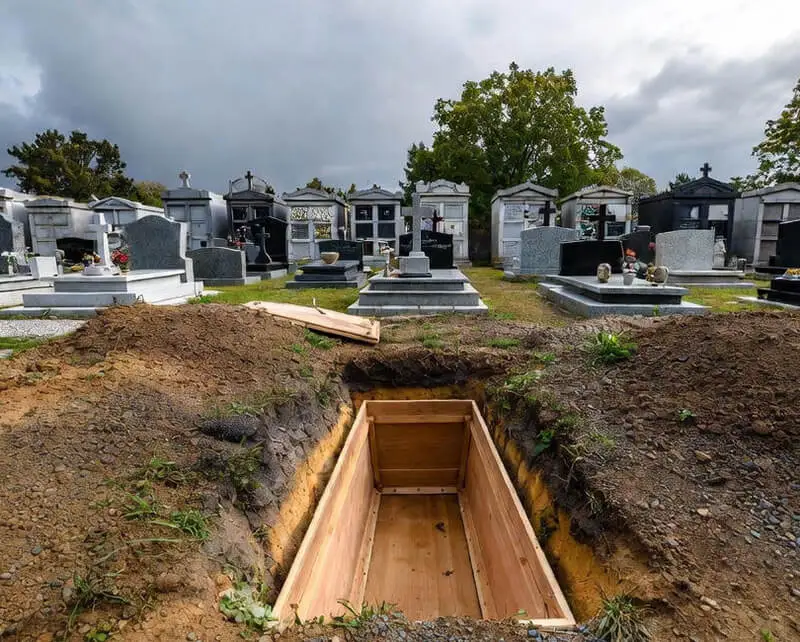
Cemeteries do have rules when it comes to burial containers. Some require the use of vaults or grave liners. This is for practical reasons. Without vaults, as coffins decay, the ground subsides. This causes a cemetery to be bumpy and uneven and is therefore hard to maintain.
State laws vary from one state to another. Some states, by law, have these vault requirements. Others leave it to the discretion of the individual cemeteries. In California, for instance, most cemeteries require vaulting, although, by law, it is not a requirement. In Texas, there is no requirement for vaulting, either by state law or most cemeteries.
Environmental laws are also important. The EPA is monitoring cemeteries so as not to contaminate groundwater. Old burial practices utilized embalming chemicals that were toxic. With modern regulations, there are limits on what is placed in the ground. These rules serve to protect the water supply for the living.
Jewish and Muslim burial traditions often lean toward simple burials devoid of vaults. These faiths teach that the body should return to earth in natural ways. Many cemeteries will create special sections just for the conduct of these religions’ burials. They work with the family to help in honoring their traditions while working within local rules.
Final Thoughts
So do coffins fill up with water? Yes, almost all of them do over time. This may sound sad or disturbing in the beginning. But it sustains the idea of a natural process. Our bodies came from the earth and return to the earth. Water is part of that cycle.
Understanding this process will lead to informed decisions. The families can select burial options that go with their value systems and available budgets. They can go for metal caskets and vaults for better protection. Or they can decide on natural burial for a faster return to nature. Both are fair choices.
Whether water gets inside the coffin is actually unimportant. What truly matters is how these persons’ memory is preserved and respected. Their memory is forever kept alive in our hearts; it cannot be subjected to physical conditions of the coffin or burial container. The love we shared with them is far more significant than what goes on six feet beneath.
This conversation links us with the greater questions pertaining to life, death, and nature. Natural processes cannot be stopped; they can only be accepted, and the mighty find peace with them. Water filling a coffin sounds cruel, yet it is part of the ever-repeating cycle that draws all lives together.