
Do Churches Typically Own Cemeteries? Understanding Religious Burial Grounds Worldwide
Table of Contents
If we are asked to talk about old villages in the countryside or historic religious sites that we could walk through, there might be something that seems almost natural: a cemetery next to a church. This has been happening for centuries, although the question of ownership is more complicated. The churches and cemeteries are related differently in different countries, cultures, and religions.
Historically, churches played a central role in matters of death and burial; however, this role has changed significantly in the modern world. To understand who owns such sacred spaces, we need to examine various instances worldwide, look back at historical practices, and take into account present-day changes to the use by societies of burial and remembrance.
The Historical Connection Between Churches and Cemeteries
For many centuries across Europe and other regions, churches maintained what was called churchyard burial. This meant that deceased members of a parish would be buried in a consecrated ground directly adjacent to or surrounding the church building. The church represents the Roman Catholic faith or later Protestant denominations, hence both spiritual and administrative authority over these areas.
This model had its root in very old religious belief. It was quite essential for the soul in its afterlife to be buried in consecrated ground, blessed by church authority. The church maintained records in detail in what were called parish registers: the birth, marriage, and death of someone in the community. This gave the religious institutions great power over burial practices and cemetery management.
Evidence from Historical Records: it is estimated that 95% of the burials in medieval England took place inside churchyards that were owned and controlled by the Church of England. The same pattern was seen for almost all of Catholic Europe, where the churches had total control of about every burial place until the 18th and 19th centuries.
Different Ownership Models Worldwide
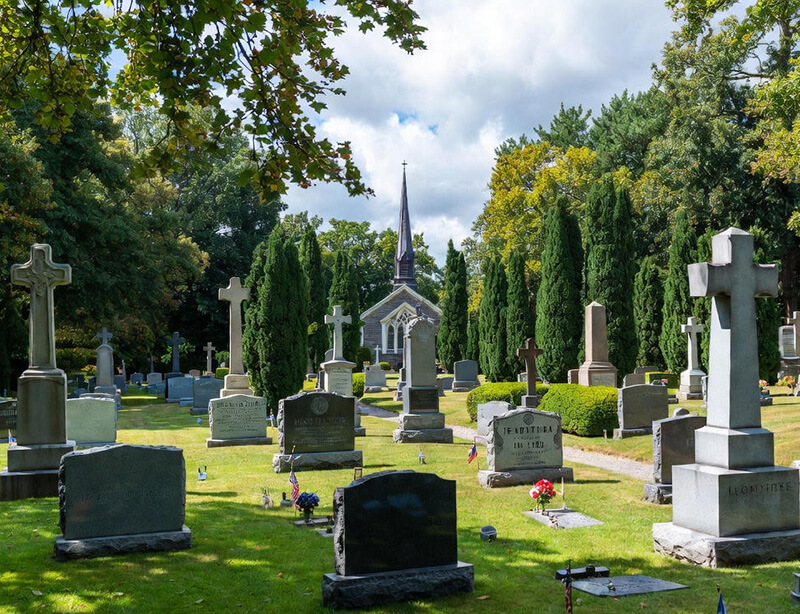
Cemetery Ownership Today: There are variations in the models that currently have churches involved. The level of role played by a church varies widely from one country to another. In some states where a religious organization dominates, in others, almost completely taken over management has been secularized. Knowing these differences brings one an appreciation of the burial tradition in other parts of the world.
The UK Model: Many historic churchyards in the UK are still church-owned, particularly those of the Church of England and the Church in Wales. The original intention of consecrated ground is still preserved today, though the constrained spaces have witnessed a decline in other new graves. The church, as maintainer, held onto historical sites and the ancient headstones of cemeteries that tell centuries of local history.
The French System: France presents a completely different picture. The transfer of cemetery ownership from religious authorities to municipal governments followed the French Revolution with the subsequent law of secularization, above all the 1881 law on freedom of burial. French cemeteries are today in the hands of local government authorities, although religious symbols and separate areas for different faiths are still provided.
The German Way: Germany demonstrates yet another model where both church owned and municipal ones coexist as a cemetery. Many communities have Friedhöfe (cemeteries) managed by religious organizations, while others fall under city administration. This mixed system reflected Germany’s recognition of churches as corporations of public law that still entitles them to some administrative privileges.
European Examples of Church-Owned Cemeteries
Let me provide a few examples that showcase how the church ownership works in Europe in a rather real sense. It portrays the human aspect behind cemetery management and the different emotional ties people share with these sacred spaces.
The story of the graveyard at St. Patrick’s in County Cork speaks about traditional church ownership, exemplified in rural Ireland. This cemetery, belonging to the Catholic parish, has been operated for over 300 years, with burial rights granted to families from generation to generation. Father Michael O’Connor, who serves these communities, explains that it is not only the church that is bereaved of new burials, but it also aids the families in restoring historical cemetery headstones. The oldest markers date back to the 1700s, telling stories of farmers, fishermen, and local heroes in English and Irish Gaelic inscriptions.
When we come over to Scandinavia, it shows how the Lutheran way influences the Swedish style. The Svenska Kyrkan (Church of Sweden) used to own all cemeteries back in the days, but reforms occurred in 1996, giving the ownership to independent boards, albeit with close ties to church parishes. For instance, Skogskyrkogården (The Woodland Cemetery) in Stockholm, a UNESCO World Heritage site. Apparently this cemetery is managed by the City of Stockholm, but it works with the Church of Sweden for conducting religious services and there are sections set aside for different faith communities.
Statistical Evidence: According to a survey by the European Cemetery Association states that 42% of cemeteries in EU countries entertains some form of church involvement through direct ownership, management contract, or administration with municipal authorities on a shared basis.
In Poland, the Catholic Church remains really strong. The Powązki Cemetery in Warsaw that was founded in 1790 is under the administration of the Archdiocese of Warsaw. The cemetery is massive, housing the graves of numerous Polish national heroes, artists, and political figures. The church’s role transcends mere administration; they hold masses for the deceased on a regular basis, maintain elaborate cemetery headstones and monuments, and give spiritual help to grief-stricken families. Anna Kowalska, whose family has had a plot there for four generations, described how the involvement of the church brings her family comfort: “Knowing that priests pray here regularly and that this ground is blessed brings peace to our family.”
Religious Burial Grounds in the Asian Perspective
Asia shows intriguing variations with respect to the functions of burial grounds in relation to religious institutions. These instances do enlighten on the fact that the cemetery is not compulsorily owned by a church but may well depend on cultural, religious, and even governmental imperatives.
Churches really closely mirrored the historical European model in providing cemeteries for their members. Parishes maintain their own camposantos (holy fields), notably in the rural areas. The Parish of San Sebastian in Nueva Ecija has a cemetery in which generations of families have been buried since the time of Spanish colonization. Father Ramon Dela Cruz, parish priest, is responsible not only for burial services but also annual celebrations of Undas when families congregate for the cleaning of graves, replacing of flowers, and sharing of meals alongside elaborate cemetery headstones decorated with photos, candles, and religious symbols.
In Japan, on the other hand, the view has been through the bochi, cemeteries belonging to Buddhist temples: not churches, but built up among Buddhist temples. Zōjō-ji Temple in Tokyo maintains a graveyard containing thousands of graves, where all families are believed to pay for the permanent plots. It is the temple that owns the land itself, whilst families buy “eternal use rights”, rather than owning the land outright. It is the temple that maintains the ground facilities, conducts memorial services, and preserves historical stone markers called haka, which function in a manner similar to Western cemetery headstones, incorporating specific Buddhist motifs and Sanskrit letters.
Such a challenge in modernity, unique yet not lacking challenge in that tradition, might be something that South Korea is currently facing in terms of ownership of traditional religious cemeteries. For instance, Buddhist temples and Christian churches had their burial grounds for several decades. However, severe land shortage conditions, particularly around Seoul and other major cities, have prompted the government to enforce stricter regulations. Cemeteries are, however, managed by the municipal and national memorial parks, which are gradually coming about by the Natural Burial Cemetery Act promulgated in 2000 and various reforms made thereafter. The adaptive-cum-modernizing trend upon which the Christian churches in South Korea, such as the Yoido Full Gospel Church in Seoul, have shaped themselves to move toward in availing memorial walls and columbariums instead of conventional burial grounds has indeed shown space limitations and shifting preferences.
Case Study: Singapore illustrates how multi-religious societies cope with burial grounds. All public cemeteries are managed by the government through the National Environment Agency, which allocates sections to different religions. Religious organizations, such as a Christian church, a Muslim mosque, or a Hindu temple, can now conduct the necessary services, but they do not own the land on which those cemeteries are situated. This way, access would be equal and minimal in disrespecting the various rituals of saying farewell.

Cemetery Headstones and Religious Symbolism
In cemeteries owned by the church, those headstones impart heavy stories that relate to faith, community, and remembrance. These markers are not merely identifying plaques; they express the religious belief, social status, or personal memory of the deceased. To respect the deeper meanings inherent within church-managed cemeteries, we need to go beyond the surface of headstones.
In Greece, Orthodox cemeteries abound wherein headstones embody the Byzantine traditions of art. At the First Cemetery of Athens, managed by the Church of Greece, highly ornate marble headstones have icons of saints, crosses, and photographs of the deceased within weatherproof frames. As Maria Papadopoulos, a stonemason who has been in her family for three generations crafting cemetery headstones, explained, families work closely with priests to ensure that what they put on it is theologically creative. “A headstone in an Orthodox cemetery is not just a marker; it is a prayer in stone, a permanent petition for the soul’s repose,” she said.
The symbolism differs according to denominations and cultures. In Scotland’s Presbyterian churchyards, traditional gravestones often bear the symbolism of the winged hourglass, which stands for the passage of time, and that of a death’s head, a skull representing human mortality. Gothic Revival symbols of angels, urns, and broken columns were introduced later in Victorian churchyards according to local Anglican customs, thereby creating a communicative structure viewed with shared understanding among community members, if sometimes imposed or required by church authorities.
Portuguese Catholic cemeteries, many still church-managed, display another unique tradition. The Cemitério dos Prazeres in Lisbon, owned by the Patriarchate of Lisbon, is laid out with elaborate mausoleums and headstones on the facade of azulejo tiles—traditional ceramic artwork from Portugal. These vivid cemetery headstones express religious narratives, particularly embodying Nossa Senhora (Our Lady) and Cristo Redentor (Christ the Redeemer), thereby creating a faith-inspired, outdoor gallery within the cemetery.
Modern church-interred cemeteries grapple between the traditional headstone and modernistic trends in designs. Some religious authorities have maintained uncompromising rules as to the size, materials, and iconography in order to maintain the character of the cemetery, while others have eased such restrictions in tune with changes in public taste but still require that some religious element remains. The process of finding this balance, then, serves as an avenue for expressing much wider tensions of how religious institutions begin to engage modernity.
Modern Challenges and Changes
Contemporary churches with cemetery properties are subjected to unprecedented challenges their predecessors hardly contemplated. These issues are prickly even in their scope, forcing religious authorities to redefine relationships with graveyards and their practices according to 21st century realities.
Space Scarcity: Perhaps the most acute problem is no space left for future use. Cities all over Europe and Asia boast of historic churchyards but, fell short of being hallowed in and completely packed with bodies, has no room for further expansion. The Church of England estimates that 80% of its churchyards are now closed for new burials except for those remaining family plots. Most importantly, churches need to treat these areas as heritage sites rather than operative graveyards, since preservation-quality cemetery headstones covering centuries are now mostly non-profitable due to absence of new interments.
Italy has, on the other hand, contributed, citing this challenge as an impetus for ingenious interventions. Following similar space challenges, the Catholic Church of Milan took from examples and established as well the Cimitero Monumentale with huge above-ground tomb structures and columbariums, thus admitting continued burials on the premises, managed by the Church while maximizing confined spaces. This cemetery has thus turned to becoming a societal landmark as among those cultural treasures of Italy, home to sculptured cemetery headstones and monuments designed by prominent Italian artists.
As for the Economic Squeeze: It is actually significantly more expensive to maintain historic graveyards than to earn income from burial fees. In rural England, many small parish churches seek to manage their churchyards, which would involve repairing damaged headstones in cemeteries, managing grass, and ensuring safety for paths. The Church Conservation Trust states that maintaining churchyards costs English parishes approximately £50 million a year, funds that would otherwise be used to support the ministry actively.
Belgian parishes resolved the issue through partnerships with the municipalities nearby. The govt then provides funds for the maintenance of cemeteries under that premise of considering these sites as part of the culture heritage, while retaining ownership and spiritual authority within the church. Because of this, the religious ties remain intact but financially sound.
Changing Attitudes: Younger generations prefer cremation over burial, and even in cases where burial is decided, it does not necessarily matter whether it is close to a church as was the case previously. Churches will have more competition from secular memorial parks, which offer their customers more flexible options. Some churches have begun developing nature burial grounds and columbarium walls. Others have begun establishing memorial gardens-all designed to appeal to modern environmental consciousness while still incorporating prayer or spiritual themed elements.
Research Finding: According to a research conducted in 2020 by International Church Cemetery Association, the traditional church-owned cemeteries that were located in Western Europe witnessed an annual 40% decline in new interments from the year 2000 to 2020. This was attributed to the increase in the rates of cremation and the people’s preference for municipal or private memorial parks as alternatives to the traditional cemeteries.
Conclusion
Do churches own cemeteries? The answer depends on where you are in the world and the historical period in question. For long, lying embedded in the hearts of many societies- Christian ones in particular-has been the historical fact that burial grounds were owned and managed by churches. This has continued for centuries, as far as spiritual authority could naturally exercise its control over the buried. Today’s picture, however, is much more complex and varied than that.
As in many such communities, particularly under the conditions of traditional lifestyle-rural Ireland, Poland, Greece, and on-the churches have yet to go with owning or managing the cemetery, as they have done in generations past. Those headstones are testimony to centuries of faith, community life, and dying. But in most urbanized and secularized societies, the government has been taking over the cemeteries and relegating churches to a ceremonial role.
The Philippines, Japan, South Korea, and the European countries give a picture that, indeed, no universal model exists. Cemetery ownership must reflect the unique way that a society defines the relationship between religious authority and governmental power and cultural traditions pertaining to death and remembrance.
In church, there is a cemetery, and space, money, and societal attitudes slowly evolve. Some will remain as is; some will engage in partnerships with municipal authority; whereas others may gradually relinquish ownership while still holding spiritual ties.
However varied all these may be, one thing remains constant: the deeply human need to remember and honor those who have passed. Cemeteries, whether owned by churches, governments, or private organizations, would be the most tangible links to the past and present: the living and the dead. The stories-lively, tragic, tangible, and yet-to-be-discovered tales of individuals, families, and communities-continuously told through cemetery headstones-simple or elaborate, religious or secular-are worth saving despite whoever happens to call themselves the legal owners of the earth under which they were buried.
Professional Headstone Manufacturing Services
We are a professional tombstone manufacture, dedicated to beautiful and lasting cemetery headstones that honor your love ones with dignity and craftsmanship. Contact us to have a consultation on your memorial needs.